

AHK-Cu
AHK-Cu is a copper-binding tripeptide composed of alanine, histidine, and lysine. It is studied for its potential role in supporting cellular repair, extracellular matrix activity, collagen-related pathways, and hair follicle biology through copper-dependent signaling mechanisms.
Reconstitution and Storage
Most standard lyophilised research vials use 2mL of bacteriostatic water for preparation. However, always check the product page or vial label for specific instructions.
For best handling, slowly add the bacteriostatic water along the inside wall of the vial. Avoid adding it directly onto the powder. This approach helps reduce unnecessary agitation and supports product integrity during laboratory use.
Next, gently swirl or roll the vial until the lyophilised powder fully dissolves. Avoid aggressive shaking. Excessive agitation may affect product stability.
After preparation, store the vial in a refrigerator between 2–8°C for best stability. Meanwhile, keep unprepared lyophilised vials in a cool, dry environment. Protect them from direct sunlight, moisture, and excessive heat.
Finally, follow the storage and handling instructions provided with each product. Proper handling helps maintain product purity, consistency, and reliability throughout laboratory applications.
AHK-Cu in Canada
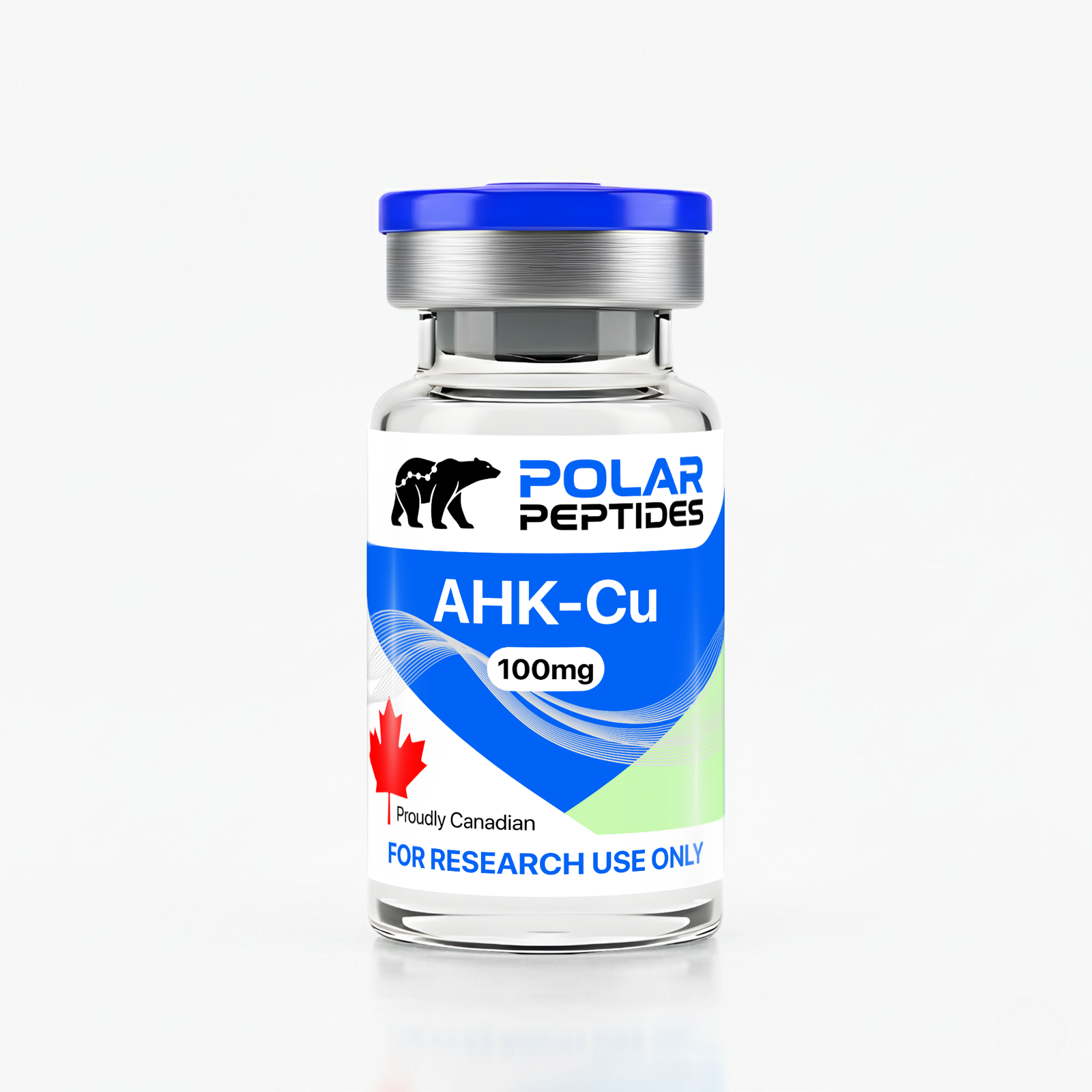
Polar Peptides supplies AHK-Cu in Canada as a lyophilised powder in sealed 100mg research vials. You can order a single vial, a 3-vial pack, or a 10-vial pack. AHK-Cu is a copper-binding tripeptide complex studied alongside other copper peptides in matrix and follicle research models.
About AHK-Cu
AHK-Cu is a tripeptide complex made from alanyl-histidyl-lysine (AHK) bound to copper. It provides a close structural counterpart to the better-known GHK-Cu. However, the two compounds differ at one position. AHK-Cu contains alanine instead of glycine at the first residue.
This single substitution provides the basis for comparative research. Glycine has no side chain, while alanine carries a single methyl group. Therefore, researchers can compare the two complexes to examine how a small structural change affects copper coordination and downstream behaviour.
Research with AHK-Cu focuses on copper-peptide chemistry. In addition, researchers study the compound in hair-follicle and dermal models. These studies often compare AHK-Cu and GHK-Cu as a matched pair.
Key Research Areas
- Copper coordination chemistry in tripeptide complexes
- Single-residue substitution comparative research
- Hair follicle and dermal research models
- Extracellular matrix signalling studies
- Matched-pair analogue design
Specifications
- Format: Lyophilised powder in a sealed research vial
- Size available: 100mg
- Pack options: 1 vial, 3 vials, or 10-vial pack
- Stated purity: 99%+
The Comparison Peptide and Related Material
Its direct comparison peptide is GHK-Cu, which is available in 50mg and 100mg formats.
The copper tripeptide also appears in the Glow and Klow blends. In addition, it is available in a GHK-Cu face cream with hyaluronic acid.
Frequently Asked Questions
How does AHK-Cu differ from GHK-Cu?
AHK-Cu differs from GHK-Cu by a single residue. Alanine replaces glycine at the first position.
How is the 100mg vial sold?
You can order the 100mg vial individually, in a 3-vial pack, or in a 10-vial pack.
Research Use Only
AHK-Cu is supplied strictly for research use only. It is intended for qualified laboratory, analytical, or educational research applications.
| Size | 100mg |
|---|
Related products
Anti Aging

Anti Aging
Anti Aging
Anti Aging
Anti Aging
Anti Aging
Anti Aging
Anti Aging